
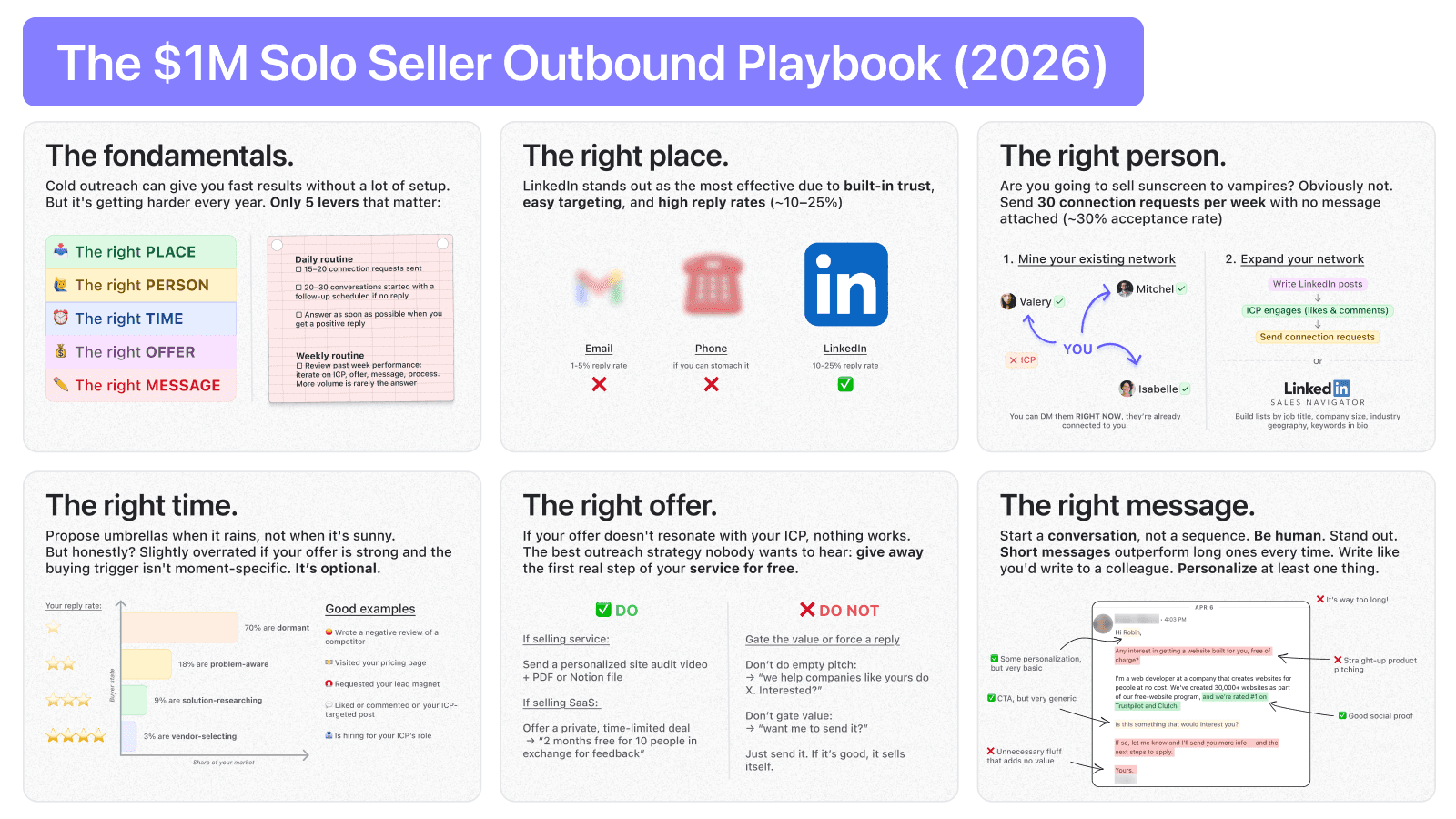
Most solo sellers do not fail at outbound because they lack tools.
They fail because they build a machine before they have a motion.
They buy a sequencer. Add a CRM. Plug in enrichment. Automate LinkedIn. Scrape emails. Write nine-step sequences. Then somehow end up with fewer real conversations than someone sending twenty thoughtful DMs a day.
That is the wrong order.
If you are selling alone in 2026, LinkedIn outbound can still build a serious pipeline. Even a $1M pipeline. But not because LinkedIn is magic, and not because you found the perfect automation stack.
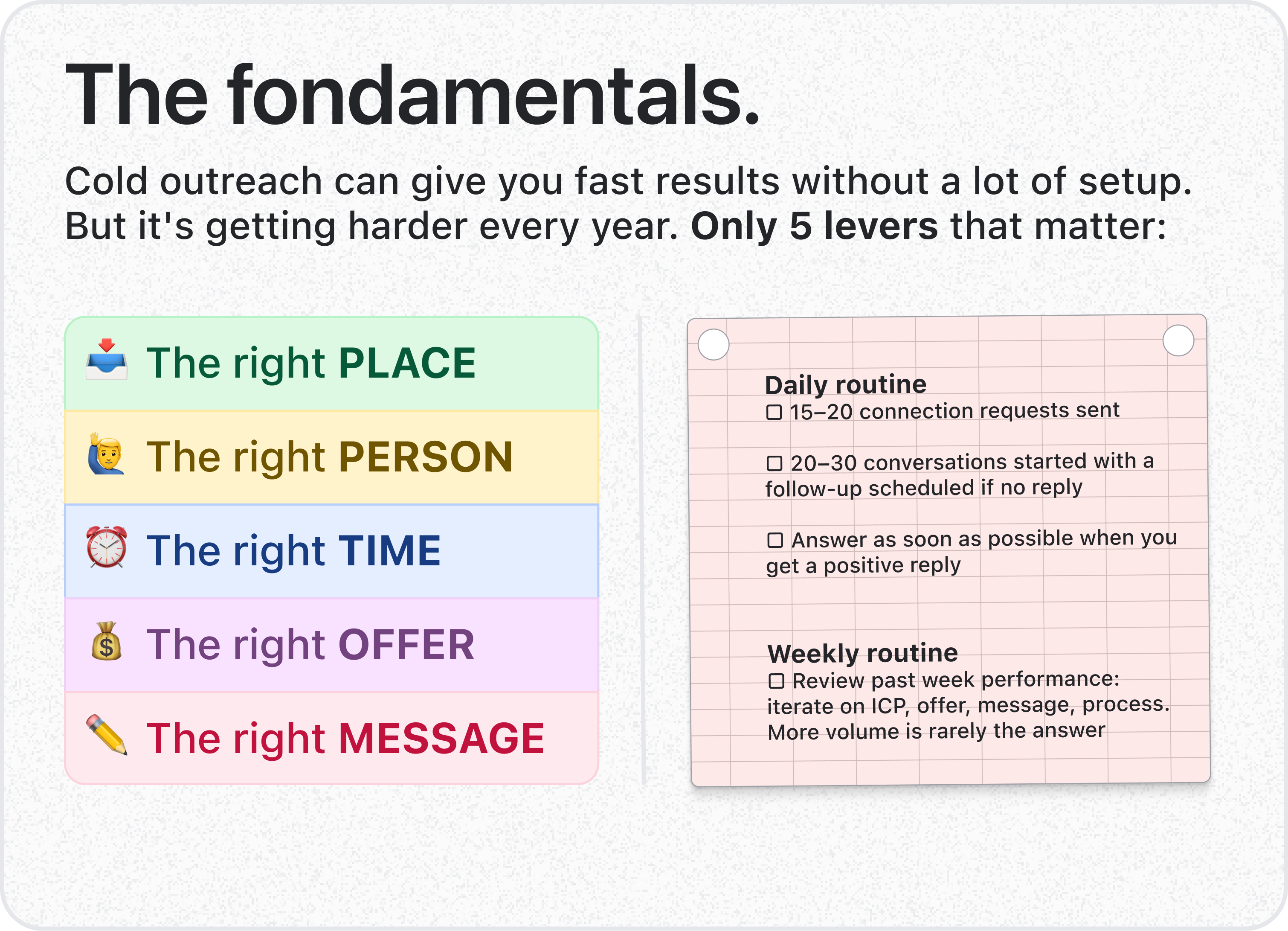
It works when five things line up:
- the right person
- the right place
- the right time
- the right offer
- the right message
That is the whole system.
Simple, not easy.
TL;DR
If you want the short version, here it is:
- Use LinkedIn as your first outbound channel.
- Start with people already in your network.
- Expand with targeted connection requests.
- Lead with a concrete offer, not a vague pitch.
- Send short messages that sound like a person wrote them.
- Follow up twice, then stop.
- Review the numbers every week.
The daily routine is small on purpose:
| Daily action | Target |
|---|---|
| Find relevant prospects | 15-20 |
| Send connection requests | 15-20 |
| Start conversations | 20-30 |
| Follow up old conversations | 5-10 |
| Review replies and objections | 5 minutes |
This is not a volume game at the beginning.
It is a relevance game.
First, what does "$1M pipeline" actually mean?
A $1M pipeline does not mean $1M in closed revenue.
It means you have created enough qualified opportunities that, if your average close rate and deal size hold, the total potential value in your active sales conversations reaches $1M.
The math is boring, which is good:
| Average deal size | Opportunities needed for $1M pipeline |
|---|---|
| $5,000 | 200 |
| $10,000 | 100 |
| $25,000 | 40 |
| $50,000 | 20 |
For most solo sellers, the real question is not "Can I send enough messages?"
You can.
The real question is:
Can you start enough qualified conversations with people who actually have the problem, budget, and reason to care?
That is where LinkedIn is useful.
Why LinkedIn is still the cleanest first outbound channel
LinkedIn has one unfair advantage over cold email:
Your profile does part of the selling before the first message.
With cold email, the buyer often has no idea who you are. Before you even reach the inbox, you need domains, deliverability, warming, enrichment, verification, copy, sequencing, and tracking.
With LinkedIn, the trust layer is already visible.
People can check:
- your face
- your headline
- your posts
- your work history
- your mutual connections
- your credibility signals
- whether you look like a real person
That matters when you are selling as a solo operator.
You do not have a famous brand behind you. You do not have a sales team creating air cover. You do not have infinite volume.
So you need the channel where trust can be built fastest.
For many founders, consultants, freelancers, recruiters, and early-stage SaaS teams, that channel is LinkedIn.
The five levers of LinkedIn outbound
Most outbound advice overcomplicates the problem.
The system comes down to five levers:
| Lever | Question it answers |
|---|---|
| Right place | Where should you reach people first? |
| Right person | Who is actually worth contacting? |
| Right time | What makes the outreach relevant now? |
| Right offer | What useful first step can you give them? |
| Right message | How do you make it easy to reply? |
Most sellers obsess over the last one.
They rewrite the first line 47 times. They ask AI for "10 personalized openers." They test hooks like they are writing ad copy.
The message matters.
But it cannot save bad targeting or a weak offer.
If you sell the wrong thing to the wrong person, no copywriting trick will fix it.
Lever 1: the right place
For a solo seller, "multi-channel outbound" sounds smart.
Usually, it just creates complexity too early.
Email plus LinkedIn plus phone plus WhatsApp plus retargeting plus CRM workflows can work when you have a team, clean data, and enough volume to learn from.
But at the beginning, focus wins.
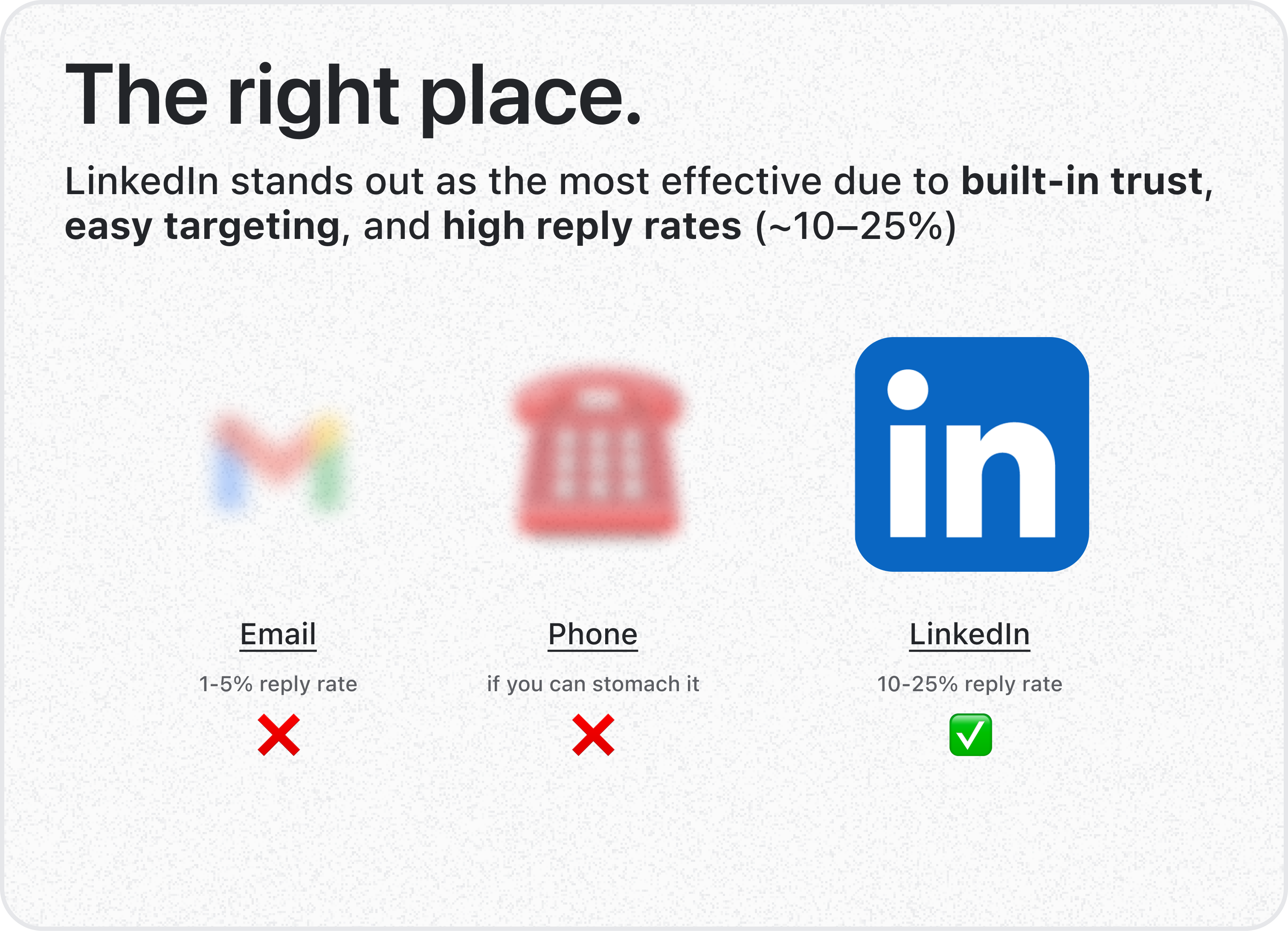
LinkedIn is a strong default because:
- you can find prospects without buying a database
- you can qualify people manually before reaching out
- you can build trust through your profile and content
- you can message people without setting up email infrastructure
- you can start with your existing network
Cold email can work. Cold calling can work too.
But if you are trying to build your first repeatable outbound motion alone, LinkedIn keeps the system simple enough to execute every day.
Lever 2: the right person
Most sellers skip the easiest leads they already have.
They open Sales Navigator, build giant lead lists, and start contacting strangers while ignoring the people already connected to them.
That is backwards.
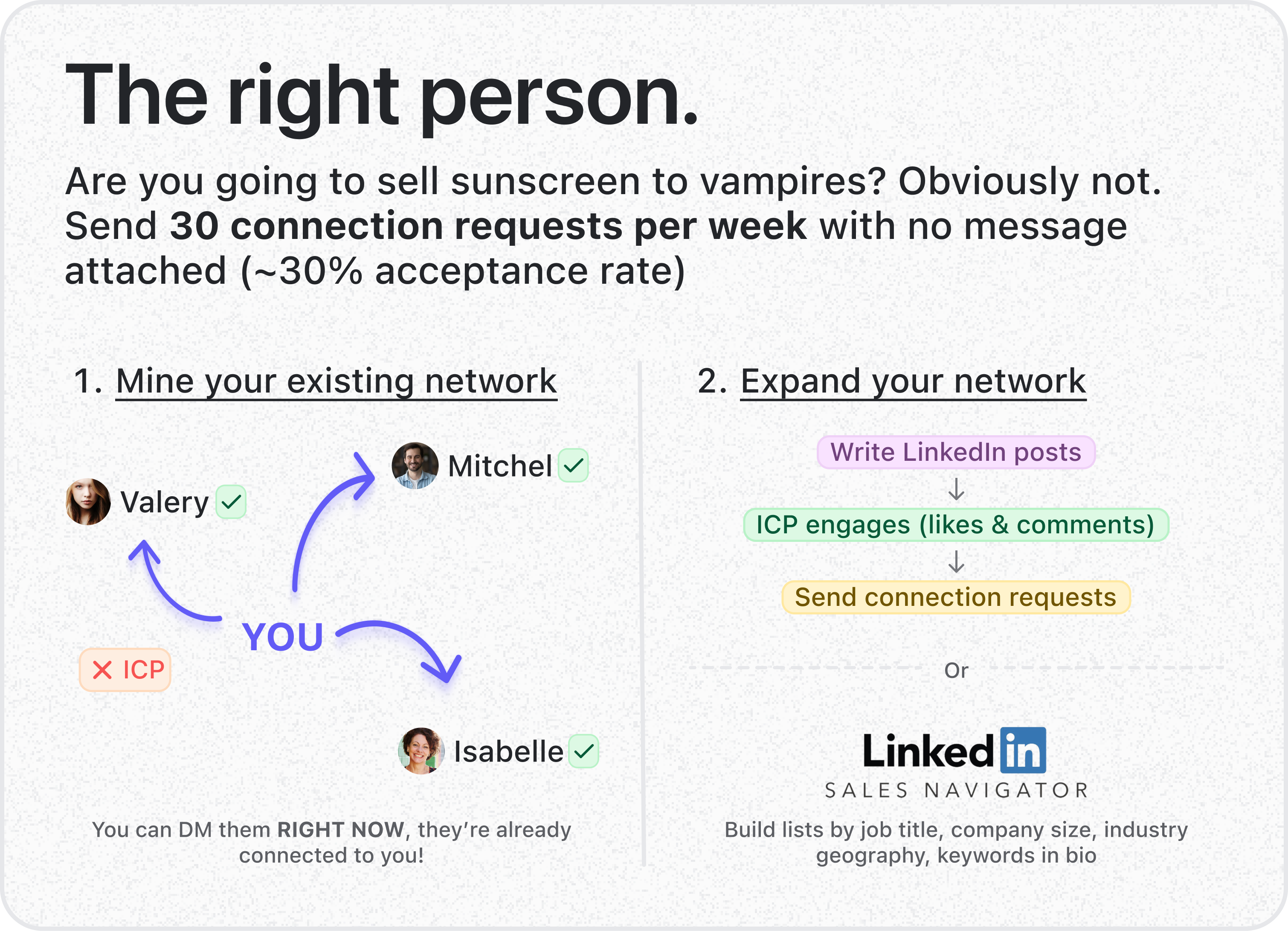
Your existing LinkedIn network is your warmest outbound asset.
Before building a new list, ask:
- Who already knows me?
- Who fits my ICP?
- Who changed jobs recently?
- Who liked or commented on my posts?
- Who works at a company that could buy?
- Who have I not spoken to in six months?
You probably have twenty people you could message today without sending a connection request.
Start there.
The trust barrier is lower, and the feedback loop is faster.
Example message for someone already in your network
Here is the version most people would send:
Hey Alex, saw you’re now leading growth at [Company]

I’m working with founders on improving their LinkedIn outbound setup, and thought this might be relevant given your new role

I recorded a quick teardown of 3 things I’d change in your current approach

Want me to send it over?
That is fine.
But it still creates an unnecessary permission step.
If the value is real, send it:
Hey Alex, saw you’re now leading growth at [Company]

I took 10 minutes to look at your LinkedIn outbound setup and noticed 3 quick fixes

Dropping them here in case useful:

[short notes or link]
This works better because the buyer does not have to do work before they get value.
How to expand beyond your existing network
Once you have worked through warm connections, expand deliberately.
You have two simple paths.
Option 1: prospect inside LinkedIn for free
Use LinkedIn search and engagement signals to find people already active around your topic.
Good sources:
- people who comment on your posts
- people who comment on competitor posts
- people who engage with industry creators
- people using keywords related to your problem
- people with relevant job titles in relevant markets
This works because activity creates context.
Someone commenting on five posts about outbound, hiring, recruiting, founder-led sales, or pipeline generation is warmer than a random name in a scraped list.
Option 2: use Sales Navigator
Sales Navigator becomes useful when you need sharper targeting.
You can filter by:
- job title
- company size
- geography
- industry
- seniority
- keywords
- company headcount growth
- recent job changes
The mistake is not using Sales Navigator.
The mistake is thinking the list is the strategy.
A perfect lead list still fails if your offer is vague and your messages sound automated.
Should you add a note to connection requests?
In many cases, no.
A blank connection request can outperform a forced pitch because it feels lighter.
If your profile is clear and relevant, the recipient can understand who you are without being sold to immediately.
A simple weekly target:
- send around 30 targeted connection requests per week
- avoid pitching in the connection note
- wait for acceptance
- start the real conversation after they accept
The connection request opens the door.
The sales conversation starts after the door opens.
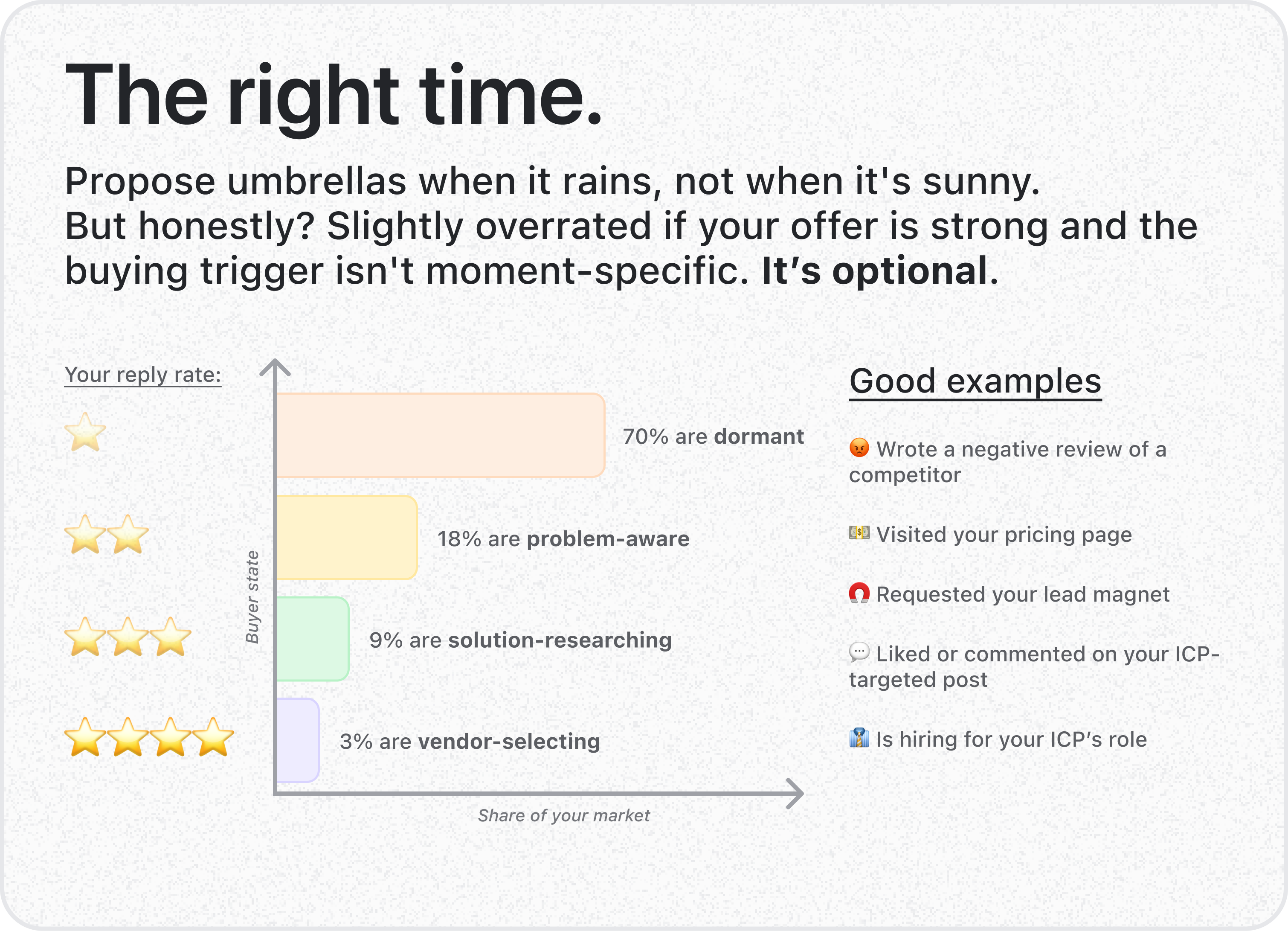
Lever 3: the right time
Timing matters.
It just matters less than most people think.
The logic behind intent signals is strong:
Sell umbrellas when it rains, not when it is sunny.
Good timing signals include:
- someone changed jobs
- someone hired for a relevant role
- someone visited your pricing page
- someone posted about the problem you solve
- someone commented on a competitor’s post
- someone raised funding
- someone launched a new product
- someone complained publicly about a pain
These signals give you context and urgency.
But they can also become a distraction.
If your offer solves a problem that is always painful, you do not need to wait for a perfect trigger every time.
A founder who lives in LinkedIn DMs always needs a cleaner follow-up system. A recruiter always needs better candidate follow-up. A consultant always needs more qualified conversations.
Timing helps.
Fit and offer matter more.
Lever 4: the right offer
This is where most LinkedIn outbound breaks.
The message is usually not the real problem.
The offer is.
A weak offer sounds like this:
- "Want to book a quick call?"
- "Can I show you our platform?"
- "Are you interested in improving X?"
- "We help companies like yours achieve Y."
That puts all the work on the buyer.
They need to understand you, trust you, evaluate the value, and give you time before they get anything useful.
A strong outbound offer flips the effort.
You give them the first useful step before asking for anything.
Strong outbound offer examples
| Seller type | Stronger first offer |
|---|---|
| SEO agency | Send three missed keyword opportunities and one fix. |
| SaaS founder | Create a sample workspace around their use case. |
| Consultant | Record a three-minute teardown with one clear next step. |
| Recruiter | Send three relevant candidate profiles and why they fit. |
| LinkedIn service provider | Show two leaks in their current DM follow-up process. |
The principle is simple:
Give them something that proves you understand the problem before asking for their time.
Bad outbound offers vs. good outbound offers
| Weak offer | Stronger offer |
|---|---|
| "Can we book a call?" | "I found three issues in your LinkedIn follow-up flow and wrote them up here." |
| "Want me to send the audit?" | "I recorded a three-minute teardown. Here it is." |
| "We help companies increase pipeline." | "I noticed two places where qualified leads are probably leaking from your current process." |
| "Would love to show you the product." | "I set up a sample workspace using your use case so you can see what changes." |
| "Are you interested?" | "Here’s the first useful thing. Tell me if it’s worth going deeper." |
The best outbound does not make the next step feel pressured.
It makes the next step feel obvious.
Lever 5: the right message
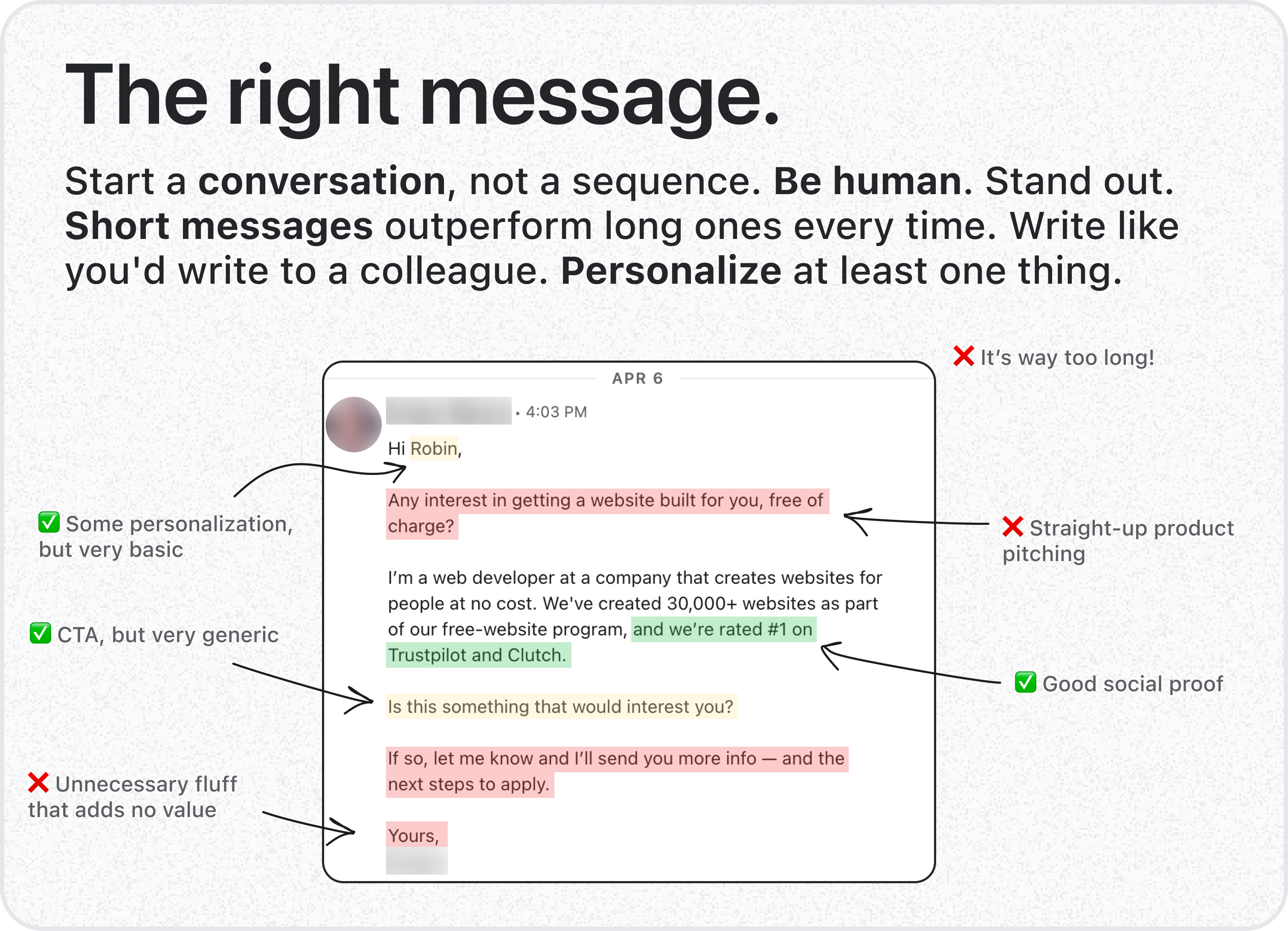
Your first message has one job:
Start a real conversation.
Not explain your whole company.
Not list every feature.
Not handle every objection.
Not prove you are smart.
Just create enough relevance for the person to reply.
A good LinkedIn outbound message is:
- short
- specific
- human
- easy to answer
- tied to something real
- useful before the call
A good LinkedIn outbound message template
Hey [Name], noticed [specific relevant thing]

I took a quick look at [company/profile/workflow] and spotted [specific problem/opportunity]

Here’s the quick version:
→ [point 1]
→ [point 2]
→ [point 3]

Might be useful if [relevant goal/pain]
This works because it gives value before asking for time.
It also sounds like a person wrote it.
A bad LinkedIn outbound message template
Hello [Name],

I’m [Name] from [Company], the leading AI-powered platform helping B2B teams optimize revenue workflows and unlock scalable growth

We work with companies across multiple industries and have helped clients generate millions in pipeline

Would you be open to a 30-minute demo next week?
This fails because it sounds like every other pitch.
It asks for time before creating trust.
It gives the buyer nothing useful.
The 20-minute daily LinkedIn outbound routine
This should not become a second job.
The goal is to create a small routine you can run every business day.
| Minute | Action | What to do |
|---|---|---|
| 0-5 | Find prospects | Check existing connections, post engagement, Sales Navigator, or recent activity. |
| 5-10 | Qualify | Remove anyone who does not clearly fit your ICP. |
| 10-15 | Send connection requests | Use blank requests or very light notes. No pitch. |
| 15-18 | Send first messages | Message accepted connections with a useful observation or deliverable. |
| 18-20 | Follow up | Follow up on older conversations and update your tracker. |
That is enough to learn.
Not enough to hide behind operations.
And that is the point.
Follow-up once after three days, once after one week
Follow-up matters.
Most sellers just abuse it.
A clean system is enough:
- first message
- follow up three days later
- follow up one week later
- stop
No "bumping this to the top of your inbox" eight times.
No guilt trips.
No fake breakup email.
No "I guess improving revenue is not a priority right now."
A simple follow-up can look like this:
Hey [Name], just following up on this

Happy to take a no too if it’s not relevant
That line works because it reduces pressure.
Pressure kills replies.
What tools do you need?
At the beginning, less than you think.
Start with:
- a simple spreadsheet
- Sales Navigator if you need sharper targeting
- a lightweight way to track follow-ups
That is enough to validate the motion.
A CRM becomes useful once you have enough conversations that manual tracking is painful.
A sequencer becomes useful once you already know what works manually.
Automation becomes useful only after you understand the human version of the workflow.
Do not automate confusion.
You will just scale bad messaging faster.
Common LinkedIn outbound mistakes
Mistake 1: pitching too early
A connection request accepted does not mean "send the full pitch."
It means you can now start a conversation.
Mistake 2: writing messages that are too long
Long messages feel expensive to read.
Short messages create momentum.
Mistake 3: pretending to personalize
Fake personalization is worse than none.
"Loved your post on leadership" means nothing if the rest of the message could go to anyone.
Real personalization connects to the offer.
Mistake 4: hiding the value
The "want me to send it?" move adds friction.
If you made something useful, send it.
Let the quality create the reply.
Mistake 5: following up forever
Two follow-ups are enough for most cold LinkedIn outreach.
After that, move on.
Your reputation is part of your funnel too.
LinkedIn outbound checklist for solo sellers
Use this before sending any message:
- Is this person actually in my ICP?
- Do I know why I am reaching out to them specifically?
- Is my offer useful before the call?
- Can I explain the value in one sentence?
- Does the message sound like something I would send to a colleague?
- Is there one clear reason to reply?
- Have I removed every unnecessary sentence?
- Do I have a simple follow-up plan?
If the answer is no, fix the basics before sending more volume.
FAQ
Is LinkedIn outbound still effective in 2026?
Yes, if you treat it as conversation-building instead of spam distribution.
The channel gets worse when sellers automate generic pitches at scale. It still works when you target the right people, send relevant messages, and make the first step useful.
Can a solo seller really build a $1M pipeline from LinkedIn?
Yes, but only if the deal size supports it.
If your average opportunity is $5,000, you need far more qualified opportunities than someone selling $50,000 deals. LinkedIn can create the conversations, but your offer, pricing, close rate, and sales process determine whether those conversations turn into pipeline.
Should I use Sales Navigator?
Use Sales Navigator when you need better targeting by job title, company size, geography, industry, seniority, or keywords.
Do not buy it before you know your ICP and offer. Sales Navigator helps you find people. It does not fix bad positioning.
Should I automate LinkedIn outbound?
Not at the start.
Manual outbound teaches you what people respond to. Automation should come after you have found a repeatable pattern, not before.
How many LinkedIn messages should I send per day?
A practical solo seller cadence is 20-30 conversation starts per day, assuming you can keep the quality high.
If quality drops, lower the volume.
What should I say in the first message?
Mention something specific, give them a useful observation, and make it easy to reply.
The best first message does not feel like a pitch. It feels like someone relevant noticed something useful.
Final takeaway
LinkedIn outbound does not need to be a complex GTM machine.
For a solo seller, the winning system is boring:
- pick the right people
- give them a reason to care
- write like a human
- follow up without being annoying
- repeat daily
Simple scales.
Fancy fails.